


Drum Lessons in Toronto for Kids and Adults
Drum lessons in Toronto at Neighbour Note are open to children, teenagers and adults, including complete beginners. Children's drum lessons can start at age 3. Drum lessons for adults have no age cap, and students don't need prior training to book.
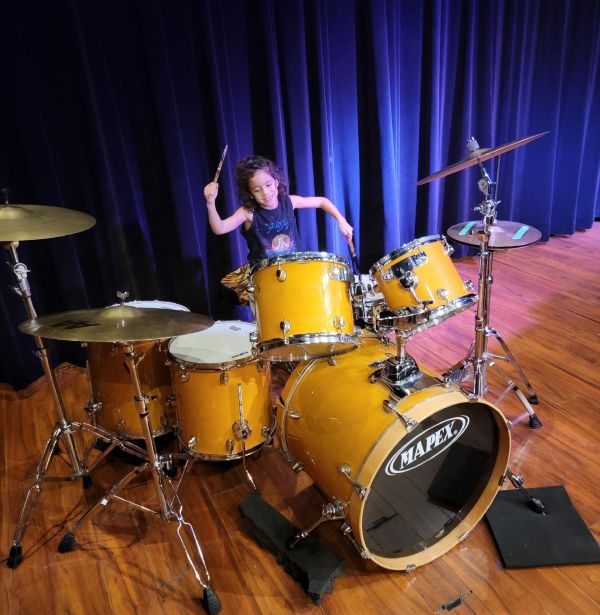
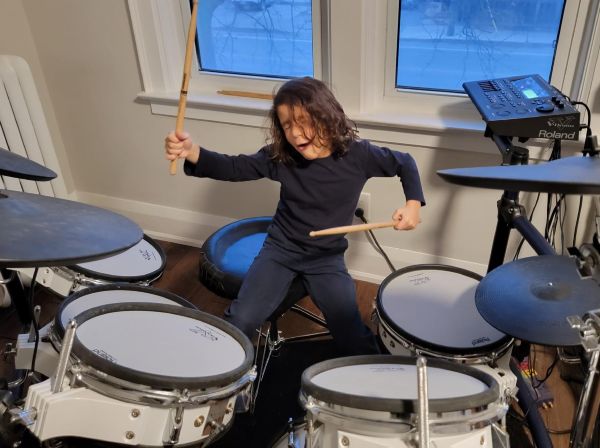
For a young child, the first months are a steady pulse, simple patterns and time on the kit that still feels like play. A 30-minute lesson is long enough to learn one new idea and short enough to hold attention. A child who can sit with a teacher for that half hour is ready to start. There is no audition and no theory test.
Adults use the same teachers and the same private format. Many arrive having never held a pair of sticks, or having stopped after a school music class. Thirty is not too late. Neither is 40. An adult who already knows which songs they want to play often settles into a practice routine faster than they expect, because the goal is specific.
Drum classes here are private, one student and one teacher. Families that want a small group can ask about group rates. Those rates are quoted on enquiry, and they are separate from the individual lesson prices below.
Drum Set and Percussion
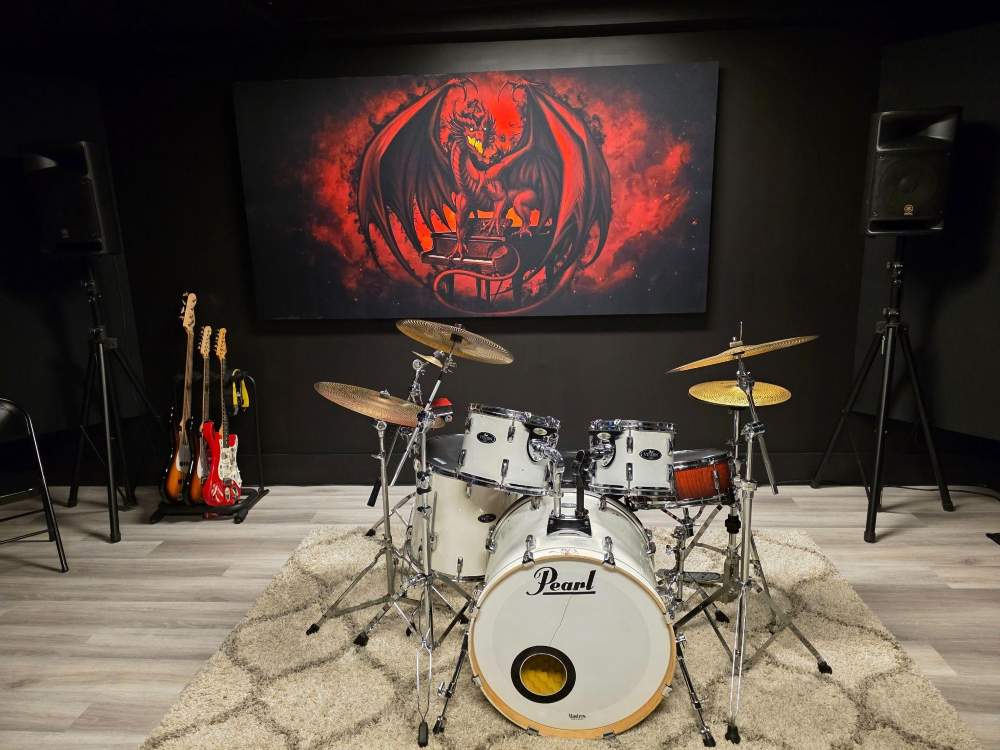
Drum set lessons and percussion lessons are both on the timetable. A drum set is the kit most students picture: bass drum, snare, toms, hi-hat and cymbals, played with sticks and pedals. Percussion lessons cover pitched instruments, such as a xylophone, and unpitched instruments, such as congas, a djembe or a tambourine.
The style follows the student and the teacher, not a single house method. Rock, pop, R&B and funk, blues, jazz, fusion, hip hop and world rhythms are all taught, depending on who you are matched with. A student who starts on a simple rock beat can later add jazz coordination or a Brazilian pattern without changing schools.
A beginner starts with how to hold the sticks, a full stroke, and a beat the hands and feet can play at the same time. Reading comes in when the music needs it, not on day one.
Hand percussion is not a side topic bolted onto the kit. Karel Gondor teaches drum set and percussion, including pandeiro, congas, repinique, and tamborim, and the studio's lesson rooms hold hand drums as well as kits. A student who wants only the drum set can stay on the kit. A student who wants both can move between them with the same teacher.
Kits, Pads and Home Practice
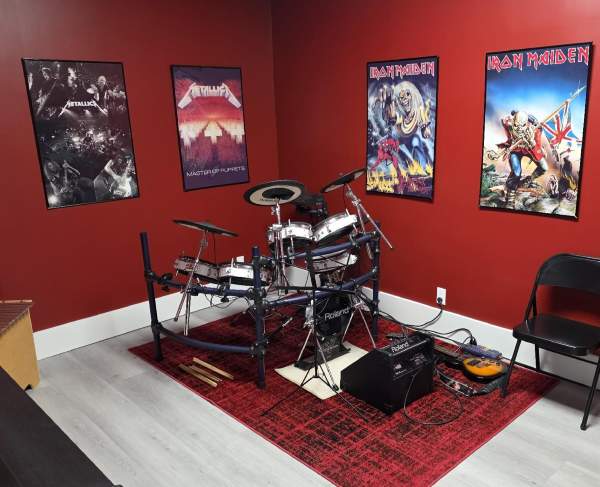
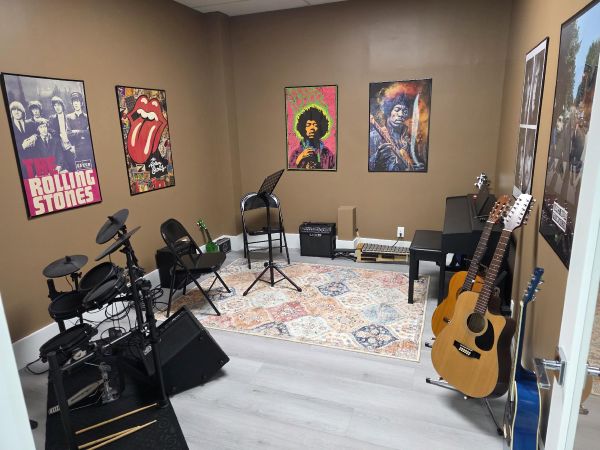
You do not have to own a full acoustic kit before a first studio lesson. At the studio, you play the school's instruments: an acoustic kit in the drum room, and electronic kits in other lesson rooms, including a Roland kit. Sticks are the one thing worth bringing if you already have a pair. If you do not, say so when you book, and the teacher will plan the first lesson around the kit that is there.
Practice between lessons is a separate question, and so is an in-home lesson. For both, families usually buy or rent a drum set. Renting is the lower-cost way to try a kit for a few months before buying. A practice pad and a pair of sticks are enough for the first weeks of hand control when a full set is not in the house yet. Many students do both. They play the studio kit at the lesson, and they use a pad at home until they know they want to continue.
An apartment or a condo is a volume problem, not a reason to put drums off. An acoustic kit is loud enough to carry through walls and floors. An electronic kit can be played with headphones, which is why it is the usual home choice in a shared building. In-home lessons work on that kind of kit. If home practice has to stay quiet, book the lesson at the studio and keep a pad by the desk for stick control during the week.
Your First Drum Lesson
A first drum lesson is 30 minutes with your teacher. The teacher listens, shows a basic stroke, and asks what you want to play. Nothing in that half hour is an exam.
On the drum set, that first half hour often includes a flam or a paradiddle and then a simple groove the student can repeat at home. On pitched percussion, it is a short scale and a simple rhythm. On hand drums, it is how the hand meets the head. The rest of the time is a conversation about the goal, whether that is a song, a school band part, or playing along with a recording.
You do not need to bring sheet music. Bring sticks if you own them. At the studio, the kit is already in the room. At home, the teacher works with the pad or the kit you have, and will tell you if that setup is getting in the way of the next step.
Drum Teachers
Drum lessons are taught by drummers whose biographies you can read before you book. The match is by style, level and schedule, not by whoever has the next open hour.
Tyler Davloor, B.Mus., graduated from Berklee College of Music in performance with highest distinction. He has played drums since age 11 and has taught since age 17. His lessons cover rock, pop, R&B and funk, blues, jazz, fusion, and related styles, built around the student's goals.
Simon Miminis, MA (Cand.), B.Mus., studied at Humber College and is completing a master's in composition at York University. He teaches drum set and percussion and is a Vic Firth-endorsed PDT instructor. Students who also want composition, recording or theory can raise that when they are matched.
Karel Gondor, B.Mus., earned his degree in drum set and percussion from Humber College. He teaches beginners through advanced students on the kit and on percussion, including pandeiro, congas, repinique and tamborim, across pop, rock, jazz, hip hop and world music.
Vennie Tu, BFA (York University), plays guitar, drums and bass and teaches drum lessons alongside piano and guitar. Full biographies for the drum faculty, and for the rest of the school, are with our music teachers in Toronto. The wider faculty has 63 teachers, 12 of them with a PhD or DMA. Each drum teacher's degrees and style are in their biography.
In-Home, Studio and Online Lessons
Neighbour Note offers drum lessons in three formats, and students can move between them. Private lessons near home, at the studio, or on a video call that uses the same teachers.
At our studio. Lessons are at 389 Jane Street, Toronto, ON M6S 3Z3, in the Baby Point Gates neighbourhood. A short walk from Bloor West Village, Swansea, Runnymede, High Park and the Junction. Studio lessons are the lower individual rate, and they use acoustic and electronic kits in the lesson rooms, so families don't have to worry about volume before the first class.
In your home. Teachers travel across the GTA, including Etobicoke, for private in-home lessons. The studio itself is in Toronto, east of the Humber river. In-home lessons suit a young child, a tight week, or a student who plays more freely in their own room. They cost a little more than studio lessons to cover the travel. You will need a pad or a kit at the house.
Online. Online drum lessons suit students outside the travel area, during a week of bad weather, or during travel. The camera needs a clear view of the hands and the feet, and headphones matter if the kit is electronic.
Individual lesson rates are the same across instruments. Studio and online lessons are $40 for 30 minutes, $60 for 45 minutes and $80 for 60 minutes. In-home lessons are $45, $65 and $85 for those same lengths. All prices are subject to change without notice. The full table is on our individual lesson rates page.
Private Drum Lessons at Neighbour Note
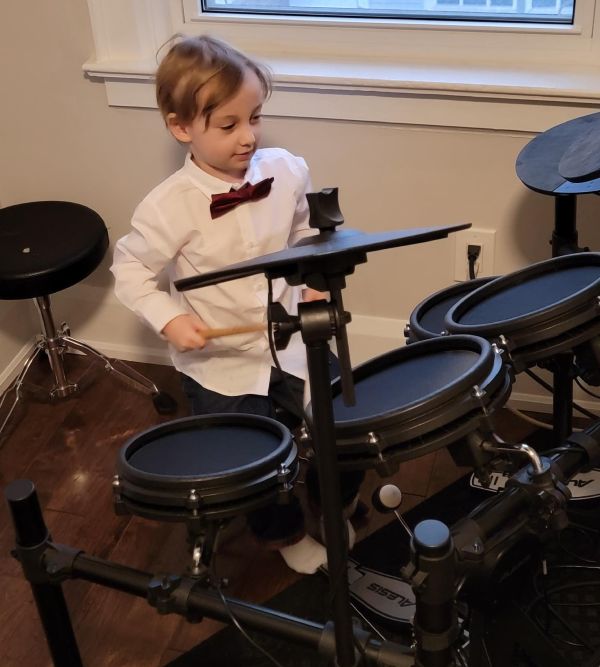
The lesson plan is built around one student. You choose the music, and the teacher builds stick control, coordination and reading around it. A child starting at 3 years old, a teenager who wants hip hop, and an adult learning a jazz ride pattern don't go through the same page of a method book.
You can check the teacher before you start. Degrees, styles and instruments are on each biography, and the studio address is a real room you can visit, with an acoustic kit and electronic kits already set up. Lessons run in your home or online when the studio is the wrong fit.
To arrange drum lessons, use the registration form or contact us. Tell us the student's age, the format you want, and whether the goal is drum set, percussion, or both.


Frequently Asked Questions
Q: How much are drum lessons in Toronto?
A: Drum lessons in Toronto at Neighbour Note are priced by length and by format. A 30-minute studio or online lesson is $40, and a 30-minute in-home lesson is $45. Forty-five minutes is $60 at the studio or online and $65 in-home. Sixty minutes is $80 or $85. All prices are subject to change without notice.
Q: Do I need my own drums to start?
A: For a studio lesson, no. You play the acoustic kit or an electronic kit at 389 Jane Street. For practice at home, and for an in-home lesson, you need something to play: a practice pad and sticks for the first weeks, or a drum set you buy or rent. An electronic kit is the practical home choice in an apartment, because you can use headphones.
Q: Is 30 too old to start drum lessons?
A: No. Adults start drum lessons with no earlier training, and the lesson is built around the songs they want to play. Thirty is a common age to begin, not a late one. Progress follows practice, as it does at any age.
Q: Is 40 too old to learn drums?
A: No. Timing, stick control and coordination are skills you train. They are not reserved for children. A 40-year-old beginner uses the same 30-, 45- or 60-minute lesson, with repertoire chosen for them rather than a school-band chart.
Q: What age can a child start drum lessons?
A:Children can start drum lessons at Neighbour Note at age 3. Early lessons work on a steady pulse, simple patterns and enjoying the kit, usually in a 30-minute lesson. Reading and longer coordination work will wait until they are useful.
Q: How long are drum lessons?
A: Drum lessons are 30, 45 or 60 minutes. Most beginners, and most young children, start at 30 minutes. A student who wants more repertoire in the same week can move to 45 or 60 minutes without changing teachers.
Q: Can I practise drums in an apartment?
A: Yes, if the kit can be quiet. An acoustic set is usually too loud for a shared wall. An electronic kit with headphones is the usual setup in an apartment or a condo, and the Jane Street studio has electronic kits as well as an acoustic kit if home volume is the problem. A practice pad covers stick control on days you cannot play the full kit.
Q: What is the difference between drum set and percussion lessons?
A: Drum set lessons are on a kit, acoustic or electronic, with sticks and a bass-drum pedal. Percussion lessons focus on other instruments, including pitched ones such as a xylophone and unpitched ones such as congas, a djembe, pandeiro, or tambourine. Some students study both with the same teacher.